Book one – A strangeness in my mind
Orhan Pamuk is perhaps one of the most famous Turkish writers of modern times, a winner of the Nobel prize for literature in 2006 and apparently the best-selling Turkish author.
It was an autumn day and I was in the shop People’s books or maybe Books for the people (Insan kitaplari) on İstiklal Avenue, browsing rather carelessly through the English language offerings. I picked up a book, The red-haired woman, then took it to café on the second floor of the shop and remained glued to my chair for what seemed like an eternity.
This chance encounter with Orhan Pamuk’s writing left me wanting more, much more. In this post and a couple of future posts, I would like to share my observations and feelings about five of his books, in order of stomache-ability.
(If we assume Orhan Pamuk’s writing is dense and say, not so easy to figuratively stomach, stomache-ability would be ease of story flow, interest to the reader and motivation to finish the book.)
It might be of interest to the reader of this blog to know that I have alternated between reading and very careful listening to the audio versions of most of these books.
“A strangeness in my mind”
OK, the book is huge, the thickness of perhaps two average bricks, an impressive 21 hours and 48 minutes of narration on the Audible app. Still, it totally takes the biscuit; it is perhaps the most easily accessible to a reader who knows little or nothing about the Turkish culture. Utterly enjoyable, the book recounts the life of the street seller Mevlut (whose name means blessed in Turkish, I believe). Mevlut meets a girl at his cousin’s wedding – when I say meets, this means he stares at her from some distance, or perhaps they cross paths and look into each other’s eyes passionately – no words are exchanged, however, he doesn’t even know her name. Mevlut is of army-going age and he spends many an hour writing to the girl with the help of an articulate friend of his, sends letters with great difficulty, etc. With even greater difficulty, he arranges to elope with the girl. Why does he need to elope? Because he doesn’t have enough money to pay for the bride price. Oh, yes, in the past, and maybe even nowadays, the father of the groom would have to negotiate a bride price with the father of the bride. Mevlut’s family is poor, so the next best thing is eloping with the girl. Then, on the night when they elope, he comes to realise, in the dark, that he’s eloping not with the girl he’s infatuated with, but with her less pretty sister.
What I love this book is the fact that it is written from the perspective of many different characters. It is as if you, the reader, read the character’s mind and become familiar with their conflicting feeling and with the thought processes that motivate their actions.
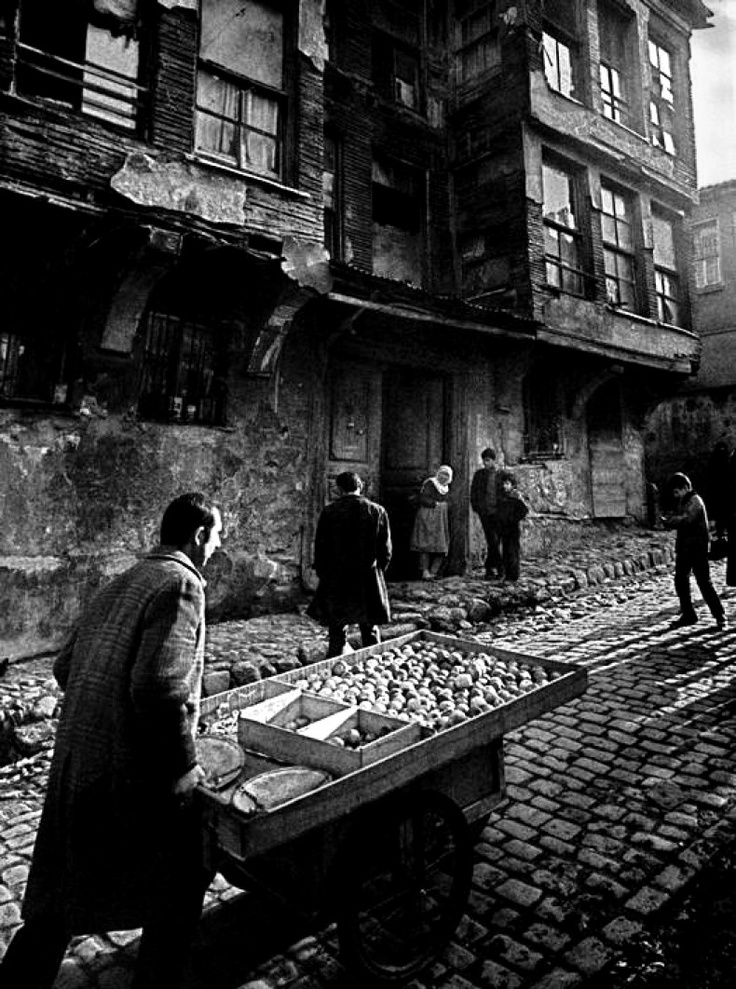
Mevlut loves the streets of Istanbul. If the streets could speak, what would they say? – he wonders. He’s perfectly happy to be out there, selling yogurt by day or boza – the thick Turkish malt drink, made from fermented barley, usually drunk in winter – by night. He’s a carefree soul unconcerned with money and the difficulties of daily life. ‘Ts a good job his wife is more down to earth. But, enough spoilers! Suffice it to say that this book completely changed the way in which I perceive street sellers, of which there are many in Istanbul, also today. Some have resorted to loudspeakers and audio recordings to save their voices from the constant straining of shouting. But, according to Orhan Pamuk, it is the emotion in the voice of the seller that sells the product. It is just so, so, sad to see the note ‘Sellers not allowed’ on the doors on many Istanbul buildings today.
Right… just one more spoiler. Even today, as you walk some of the older neighbourhoods of Istanbul, you might happen to see a basket hanging from a balcony on some of the lower-rise apartment blocks. The housewives of Mevlut’s era would shout out an order to the street seller from their balconies, and would lower a basket with some money in it. Then, they’d pull the basket with the products back up. This habit has been recently revived due to coronavirus… A brilliant solution.
This book is so much more than just the story of Mevlut. It is a portrait of an ever changing city, a city changing at such a rapid pace, it leaves its inhabitants breathless; a city whose old mossy walls are increasingly obscured by skyscrapers as the construction boom gains momentum.
A strangeness in my mind is different from other Orhan Pamuk’s books insofar as it is not so intimidatingly erudite as some of his other works. It is an enjoyable, well written book and it does its fair share of laugh-out-loud moments. The most memorable such moment, for me, happens in a discussion on Should a man meet this wife-to-be prior to the wedding? I don’t recall the exact wording, but the answer is along the lines of: Boy, if men and women met before they were married, there would be no marriages!
I wholeheartedly recommend A strangeness in my mind to anyone looking for a good, easy (if somewhat lengthy) read.
To be continued:
2) Istanbul – memories and the city
3) The red haired woman
4) The museum of innocence
5) My name is red
Image by: Ara Güler


